
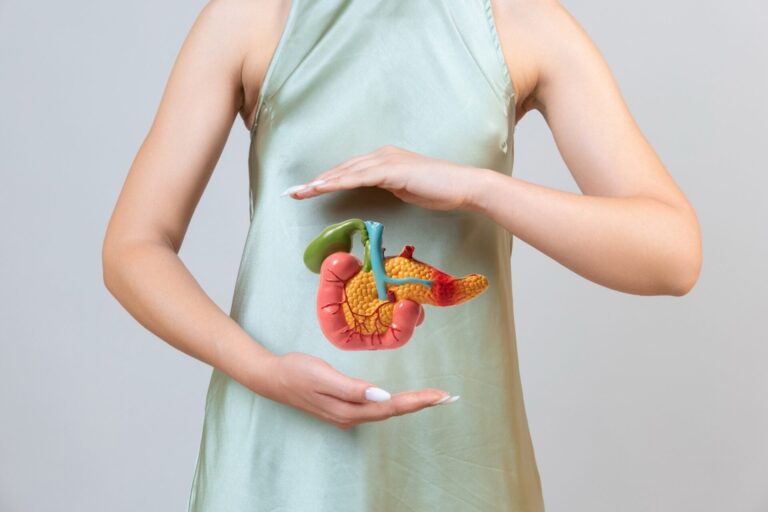
Your pancreas—a gland located on the left side of your body behind the stomach—plays a crucial role in digestion, blood sugar balance, and hormone regulation.
Your pancreas is known as a dual organ. It’s part of your digestive system and your endocrine system, producing enzymes that aid in digestion and hormones that regulate blood sugar levels and other bodily functions.
Its proper functioning is essential for maintaining a healthy digestive and endocrine system.
What Does Your Pancreas Do?
Your pancreas is a six-inch-long, flat organ located in your upper abdomen near your liver and part of the small intestine that produces digestive enzymes, or digestive juices, to help break down, absorb, and assimilate the nutrients in your food, and produce hormones that aid in digestion and help regulate blood sugar levels.
More specifically, your pancreas plays a dual role in your bodily functions:
The Digestive Process (Exocrine System):
Your pancreas works closely with your gallbladder as part of your digestive process. During digestion, your pancreas secretes essential fluids that contain digestive enzymes, which break down proteins, carbohydrates, and fats into smaller elements before they can be absorbed in the small intestine and easily converted into energy.
Enzymes produced by your pancreas for digestion include:
- Chymotrypsin and Trypsin to digest proteins
- Lipase to digest fats
- Amylase to digest carbohydrates
Hormones to control the amount of sugar in your bloodstream (Endocrine system):
Your pancreas produces hormones, such as insulin and glucagon, that help regulate and balance your blood sugar levels. Balanced blood glucose levels are crucial for the healthy functioning of your brain, nervous system, liver, kidneys, and cardiovascular system.
Insulin regulates the amount of glucose in the bloodstream and helps lower blood glucose levels when they become too high. When your blood sugar is too high, your pancreas makes insulin to lower it. Specifically, specialized cells within the pancreas, called beta cells, release insulin into the bloodstream to help facilitate the uptake of glucose by assisting cells in absorbing sugar from the bloodstream into their cells for energy.
When your blood sugar levels drop too low, your pancreas releases glucagon to raise them. Alpha cells in the pancreas produce glucagon, a hormone that raises blood sugar levels by stimulating the liver to release stored glucose.
The pancreas also produces other hormones, such as gastrin, which stimulates the production of stomach acid, and somatostatin, which inhibits the release of hormones.
Symptoms of Pancreas Fatigue
Your pancreas can easily become overworked and fatigued, impacting both blood sugar and digestion, and presenting as symptoms like:
- Gas or bloating after meals – When your gut bacteria ferment unabsorbed food, they release hydrogen and methane, causing gas and bloating.
- Undigested food in stool
- Vitamin deficiencies, in iron, vitamin B12, folate, and calcium
- Loose, oily, or smelly stools
- Diarrhea – If you can’t break down fats and other nutrients, those particles cause excess water to enter the colon, leading to watery stools.
- Abdominal pain (often in the right upper quadrant of the abdomen) – partially digested food can cause abdominal pain as it passes through your gut.
- Night blindness or blurry vision
- Weight loss without a change in diet or exercise
- Frequent urination or extreme thirst
Essential Oils to Support Your Pancreas
Essential oils can help support the vitality of the pancreas.
Plants and herbs, including essential oils, can be used to nourish and rebuild the energy of your organ systems. This process, known as tonification of the organ systems, is based on the principle that plants and herbs can be used as tonics to boost vitality and sustain the energy of the organ systems.
Essential oils have been found to help restore vitality and energy to the organs. This helps bolster the vitality of your organs—such as your pancreas—improving their ability to assimilate and utilize essential nutrients during the digestion process.
Herbal remedies, such as the Pancreas™ blend of essential oils, including Rose Geranium, Anise Seed, Geranium, Cucumber, and Rose, help tonify and balance the pancreas against overload and fatigue to support optimal function.
Anise Seed (Pimpinella anisum):
Animal studies have shown that anethole, the primary compound in the essential oil of anise seed, which comprises approximately 90% of the oil, exhibits antioxidant, anti-inflammatory, and antidiabetic properties. Anethole was found to lower high blood sugar levels in diabetic rats, according to 2011 research on “In vitro and in vivo antioxidant potential of aniseeds ( Pimpinella anisum)” found in the Asian Journal of Experimental Biological Sciences. It did this by modulating key enzymes and enhancing the function of insulin-producing pancreatic cells.
Supports the pancreas by encouraging digestive enzyme activity and hormonal balance.
A human study using anise seed powder (5 g/day for 60 days) reported a 36% decrease in fasting blood sugar among type 2 diabetic patients. Additional benefits included reduced cholesterol levels, lower oxidative stress markers, and elevated antioxidant levels (vitamins C & A).
Cucumber Seed (Cucumis sativus)
This anti-inflammatory oil is rich in antioxidants and nutrients that help soothe inflammation and support pancreatic regeneration. Cucumber seed oil is also digestive-soothing and widely used for hydration. What’s more, Cucumber Seed Oil encourages cell regeneration. It is thought to stimulate new cell growth, which may be beneficial to organs like the pancreas, and is even supposed to stimulate insulin secretion.
Geranium (Pelargonium Graveolen):
Geranium essential oil has been shown in animal studies to significantly reduce blood glucose levels and improve antioxidant status, suggesting an antidiabetic effect. In one study, oral administration of the oil (150 mg/kg) for 30 days yielded hypoglycemic effects comparable to or better than those of the diabetes drug glibenclamide. The treatment also increased antioxidant enzyme activity (e.g., SOD, CAT, GPx), reduced oxidative stress markers like TBARS, and improved liver glycogen storage—suggesting both blood sugar regulation and cellular protection.
Geranium essential oil is also a fantastic support for the liver and gall bladder. Geranium stimulates the bile ducts, enabling the liver and gallbladder to release toxins. This is a crucial component of detoxification, as it allows the body to ward off illness and infection rather than storing toxins that contribute to poor health. Due to its powerful antidepressant properties, Geranium is an excellent oil for soothing anxiety and reducing stress, which can deplete pancreatic energy.
Broader studies on essential oils indicate they’re capable of modulating key metabolic and inflammatory pathways related to pancreatic function. These include effects on insulin release, glucose uptake via GLUT4, and the reduction of stress-related cytokines (such as TNF-α and IL-1β).
Rose (Rosa damascena):
Helps calm the nervous system while supporting hormone balance. Its soothing effect enhances insulin signaling and helps modulate blood sugar fluctuations. Some studies suggest rose oil has mild anti-inflammatory effects, which may benefit the pancreas. Rose also helps calm the stress response that can disrupt blood sugar balance. Nobel Prize-winning researcher Linda Buck investigated how different odors elicit distinct responses in the brain. For example, Buck found that rose essential oil can counteract your brain’s fear response to predator odor. Her research found that smelling rose essential oil in the presence of predator odors (or other fear stimuli) can suppress your brain’s stress responses and hormonal signals. More specifically, the research found that “rose oil can block stress hormone responses to a predator odor; it is also conceivable that some transmit signals that suppress rather than activate hormonal responses associated with fear.”
Rose Geranium (Pelargonium Roseum):
Balances endocrine function, supports metabolic regulation, and assists in stress-related glucose dysregulation. Rose geranium has long been used for the treatment of blood sugar issues, such as hyperglycemia.
Inhaling rose geranium may support hormonal balance and reduce stress, which may indirectly aid metabolic health and blood sugar regulation. Some compounds in rose geranium have mild anti-inflammatory properties, which may help support the pancreas.
Apply 2-3 drops of Pancreas™ on the fifth rib (2 down from where the bottom of your bra) on the left side of the body to help put the pancreas back in balance for optimal function.
Featured Oils:
Ready to get started? Click the links below to order today:
References:
- https://pmc.ncbi.nlm.nih.gov/articles/PMC10035495
- https://pmc.ncbi.nlm.nih.gov/articles/PMC3439344/
- https://www.xiahepublishing.com/m/2835-6357/FIM-2023-00071
- https://www.ncbi.nlm.nih.gov/pmc/articles/PMC5094457/