
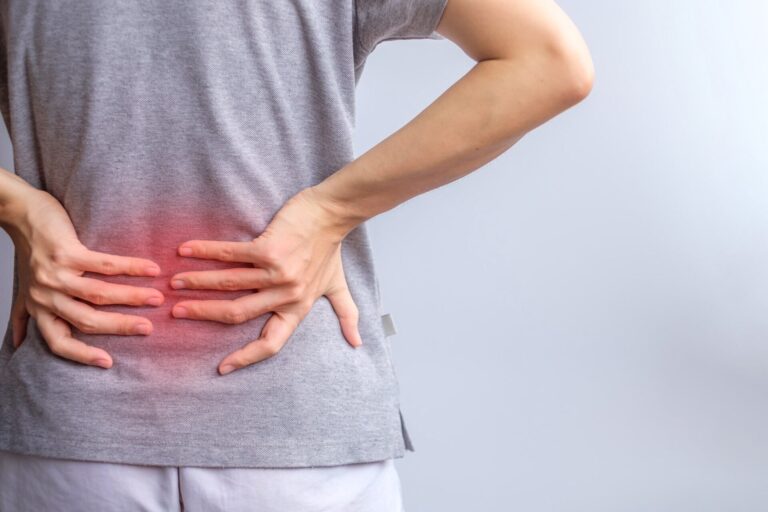
Your Adrenal glands impact some of the muscles that manage your lower back and hips, which can contribute to structural misalignments that may contribute to lower back pain and knee pain.
As you may know, your adrenal glands sit on the lower back directly above your kidneys and play a massive role in keeping the muscles of your back and your hips aligned and harmonious.
If you are highly stressed and your adrenal glands are working overtime, they may become depleted, throwing off both the release of anti-inflammatory hormones, like cortisol, and the alignment of the skeletal muscles that support your back, hips, knees, and feet.
What are Adrenals?
Your adrenal glands sit on the lower back directly above your kidneys.
They are your first line of defense when it comes to stress, responsible for the production and release of several hormones, including cortisol, (to help balance blood sugar and fight inflammation), adrenaline and noradrenaline (to provide energy to prepare your body to “fight or flee”), sex hormones, (DHEA, testosterone, estrogen, progesterone), and aldosterone, which is needed to balance electrolytes (sodium-potassium) in the body.
Moreover, in the early 1960s, Dr. George Goodheart started noticing relationships between specific muscles and specific organs or glands, finding that a weakness in a muscle can indicate an issue with the related organ or gland – an assessment system that has evolved into Applied Kinesiology.
Under prolonged stress, the adrenal glands may suffer and wear down, impacting not only stress hormone levels throughout the body, but also muscles related to your back, hips, knees, and feet.
The domino effect occurs when the adrenals are fatigued, and specific muscles are inhibited, causing the joints that muscle moves to become “subluxated” (misaligned and move abnormally), which then causes pain.
Research on Adrenal stress hormone action in skeletal muscle during exercise training found that “adrenal stress hormones have been shown to elicit specific performance benefits on the muscle” and impact the “physical function and various metabolic processes” of skeletal muscle.
Symptoms of Adrenal
Your adrenal glands may present the following signs and symptoms when under stress:
- Bright lights bother your eyes (need to wear sunglasses even on a cloudy day)
- You get dizzy when you stand up or change positions quickly
- Headaches across the forehead, over or behind the eyes
- Your eyelids twitch
- Your body jumps or twitches as you’re falling asleep
- Painful muscles and joints
- Tired feet at the end of the day or pain in the heel (plantar fasciitis)
- Daily Tasks become extremely difficult
- Sugar, Caffeine cravings
- Unexplained weight gain
- Exhausted at night, but have trouble falling asleep
- Unquenchable thirst and dry mouth
- Decreased sex drive
Adrenal Muscle Relationship
Every organ has a muscle relationship. Skeletal muscles connect with bones, tendons, and ligaments to support body movement. If an organ is distressed and not functioning well, the muscles attached to that organ will also not function well.
The Adrenal glands are associated with five muscles that support much of the lower back, hips, knees, calves, and feet, including:
- Sartorius (thigh muscle). – Your sartorius is the longest muscle in the human body, extending from the front of the hip to the knee, and serves as a central pelvic stabilizer. It helps flex the hip and knee and rotates the hip and leg.
- Gracilis (groin muscle) – a long, slender muscle located on the inner thigh that plays a role in hip adduction (pulling the leg towards the midline) and knee flexion and internal rotation
- Tibialis (shin muscle) – a major muscle in the lower leg that helps move the foot and ankle, primarily assisting in pulling the foot upwards and turning the sole inward. It also helps support the medial longitudinal arch of the foot, contributing to foot stability.
- Gastrocnemius (calf muscle) – the largest muscle in the calf plays a key role in foot and ankle movement. It connects to the femur (thigh bone) and the Achilles tendon, which attaches to the heel bone. The gastrocnemius helps with knee flexion (bending the knee joint) and plantar flexion (pointing the toes downwards).
- Soleus (calf muscle) – a powerful muscle in the back part of the lower leg that runs from just below the knee to the heel and is involved in standing and walking.
When your adrenal glands are under more stress than they can handle, these muscles will be affected, and the support to the lower back will be lost.
In other words, when the adrenal glands are not functioning efficiently, the muscles and corresponding joints they act upon may not work well either. This causes stress on those joints. Over time, the lack of proper function and support stresses the ligaments of the knee, contributing to ACL and meniscus tears, back and hip pain, and groin pulls.
Once the muscles no longer support the area, injury can more easily occur as the normal biomechanics are lost. If you ever wonder why someone suddenly “throws their back out” or wakes up with a mysterious low back ache, often it is because of an adrenal gland problem. The muscle imbalances are often there long before the symptoms occur.
For example, adrenal stress may present as weakness in the pelvis. The sartorius and gracilis muscles stabilize one side of the pelvis, holding it towards the front of the body. Weak adrenals may cause the pelvis to torque or the sacrum to misalign, contributing to low back pain or pain felt in the lower back and buttocks, often radiating down the leg or hip, which is due to the lack of pelvic stabilization normally provided by these muscles.
This holds true for knee pain as well. The three main muscles that attach just below the inside of the knee all have a strong relationship with the adrenal glands. So when the adrenals are fatigued and these muscles don’t do their job, the meniscus and MCL are under massive stress.
The sartorius and gracilis have a common insertion point where the femur (thigh bone) and tibia (shin bone) meet and help support the knee rotation. When these muscles are weak, there is a loss of stability on the inner side of the knee, closest to the other knee. The sartorius and gracilis act as dynamic ligaments, protecting and supporting the knee joint during various ranges of motion. Their function is vital in situations where the knee ligaments alone offer inadequate support. Weakness in these muscles often results in medial knee pain and meniscus injuries since many of the attachments of these muscles are located on the inside of the knee.
In addition, the muscles of the calf and feet are also related to the adrenal glands. These muscles support the stability of the foot and ankle, with weakness contributing to tired feet, weak ankles, shin splints, plantar fasciitis, and aching calves.
Finally, muscles correlated with the adrenals support the normal arch of the foot, allowing you to pronate when you walk/run naturally. Pronation is the primary way your body absorbs shock upon impact. If the muscles are fatigued, the arch will weaken, causing a pronation problem and strain to the foot and ankle. Once the foot cannot pronate correctly, the impact stress may be transferred to the knee and ultimately the lower back.
Essential Oils for the Adrenal Glands
Supporting the organs that could be affecting the muscles has been shown to help support your back, hips, knees, and feet.
Topically applied and inhaled essential oils can help lower stress and support the adrenal glands.
Inhaling essential oils is thought to help improve your body’s stress response by toning down the activity of your sympathetic nervous system and increasing the activity of your parasympathetic nervous system.
It is believed that the linalool and linalyl acetate naturally present in lavender may act as a mild sedative and stimulate the participants’ parasympathetic nervous system.
Research consistently finds that inhalation of essential oils decreases stress as measured by cortisol levels, a marker of adrenal stress. A similar study found that participants who inhaled essential oils demonstrated considerably reduced salivary cortisol concentrations than those who did not. More specifically, in the 4-week study, researchers found that anxious and stressed hypertensive patients who inhaled essential oil blends experienced “considerably reduced serum cortisol and anxiety levels compared to the control and placebo groups.”
Research has shown that elevated cortisol levels increase visceral pain sensitivity in healthy individuals. Adrenal® blend is designed to help balance the adrenals so they don’t release too much or too little cortisol, which can help manage pain.
Similar to adaptogen herbs, essential oils are also helpful for fighting stress and balancing hormones. Essential oils, including lavender, myrrh, frankincense, and bergamot, contain potent, active ingredients that have been shown to naturally lower cortisol, reduce inflammation, improve immunity, and help with sleep and digestive functions.
You can topically apply 1- 2 drops of Adrenal® on the adrenal glands (on the lower mid-back, one fist above the 12th rib on each side). Dilute to start, or if any redness occurs.
Smelling Adrenal® through the left nostril also helps to alleviate anxiety. My friend and colleague, Dr. Titus Chiu of The Modern Brain – Root Cause Neurology, explains that the over-activity of the right frontal lobe of your brain versus the left contributes to anxiety. The right brain processes the emotional aspects of the human experience, giving us empathy and compassion, but in overdrive in the right brain can contribute to heightened emotions and anxiety.
Inhaling an essential oil through the left nostril helps to stimulate the left frontal lobe and balance the over-activity of the right frontal lobe. Inhaling Adrenal® blend through the left nostril helps to stimulate the left frontal lobe and create balance between the left and right hemispheres of the brain, which then balances the over-activity of the right frontal lobe and leads to feelings of calm.
Featured Oils:
References:
- https://pubmed.ncbi.nlm.nih.gov/32506657/
- https://pubmed.ncbi.nlm.nih.gov/943425/
- https://pmc.ncbi.nlm.nih.gov/articles/PMC3583096/
- https://pubmed.ncbi.nlm.nih.gov/17291597/
- https://pmc.ncbi.nlm.nih.gov/articles/PMC3521421/
- https://pubmed.ncbi.nlm.nih.gov/17211115/
- https://journals.lww.com/pain/abstract/2019/08000/cortisol_affects_pain_sensitivity_and_pain_related.7.aspx#:~:text=Our%20data%20support%20that%20acutely,pain%20sensitivity%20in%20healthy%20individuals
- http://drtituschiu.com/